Friday, September 14, 2007

So, What Does a Bank Run Look Like?

Despite backing by the Bank of England, customers of Northern Rock PLC are flocking to withdraw their funds:

Northern Rock has 76 bank branches, according to Hunter. By 11 a.m., dozens of people formed queues on the sidewalk outside the Moorgate office, the Maddox Street branch in the West End shopping district, and the Kingston Upon Thames outlet in southwest London.

The Bank of England is stepping up to the plate, what's the issue here?

The issue is that financial markets are doing exactly what they are supposed to do. Savings is low, demand for funds is high, so the interest rate rises both encouraging savings and lowering demand. It should be a great time for the average wage-earner to toss his extra quid in a savings account and let his money work for him.

But, Northern Rock was fully loaned out. Not content to quit making more loans until their customer deposits increased, the bank went to the Bank of England and complained about the "liquidity crunch." They wanted a lower discount rate (the rate at which the Bank of England loans money to commercial banks). The problem is, a lower interest rate is a signal to consumers to save less and entrepreneurs to borrow more, thus exacerbating the "liquidity crunch."

So, Northern Rock's customers did what depositors do when their bank starts making noises about needing funds; they rushed to pull out their deposits.

"It's scary,'' said Peter Pye, 60, a retired university lecturer standing in a line of about 30 people outside the Moorgate branch in the financial district. "I have my life's savings in Northern Rock.'' He said he would withdraw a "six- figure'' sum and leave 5,000 pounds in the account.
...
"Why leave your money in a bank that obviously has some major problems?'' said Michael Ribotham, 74. "I'm not young and don't have a chance to make it back again.'' Ribotham was waiting at Moorgate for about 40 minutes.

What does "backed" by the Bank of England really mean? Well, at the end of the day, Northern Rock compares the total amount of funds they have loaned out and the total reserves they have deposited with the Bank of England. If their reserves are below the required reserve ratio, they write an IOU to the Bank of England, and the Bank of England increases their reserve account in the computer.

However, the Bank of England doesn't have a pile of money sitting there to make the loan. It increases Northern Rock's reserve account without making a corresponding decrease in another account. So, in other words, the money it loans to Northern Rock is created out of thin air.

Now, if you happen to have a few pounds in your wallet or bank account, those funds are now competing with the newly-created funds for the goods on the grocery store shelf. Through the magic of central banking, the Bank of England stole a bit of your purchasing power right out of your wallet and handed it to Northern Rock.

Keep in mind, there is no law that says Northern Rock has to be fully loaned out. There is also no law that says the Bank of England has to create new money to bail them out. But, there are things called legal tender laws which say that if someone presents you with this fiat money (which is now worth less than it was this morning) to pay a debt, you have to take it.

Meanwhile, the Bank of England is richer to the tune of the interest they charge for the loan to Northern Rock.

Is anyone concerned about the failure of this Ponzi scheme?

"There is no risk,'' said James Hamilton, an analyst at Numis Securities in London. "The Bank of England said Northern Rock is solvent.'' Hamilton said that "as credit turmoil will return to normal, Northern Rock's business will.'' The British Bankers' Association said there's "no reason for either mortgage customers or savers to worry.'' The group provides London interbank offered rates, or Libor, a benchmark for money- market rates in the dollar, the euro and 11 other currencies.

Guess not.

Labels: , , , , , , , ,

Monday, July 16, 2007

Cheap TVs and Cars - A How-To


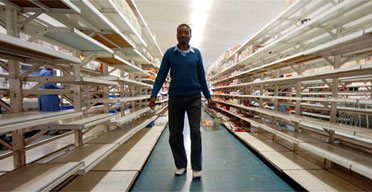
Photograph: Bishop Asare/EPA

At night, retailers dream about throngs of customers storming the aisles and snapping up the highest-priced items. The customers flood the check-out lanes with their purchases and fist-fulls of cash. It would be better than the day after Thanksgiving. Or, would it?

As with most questions the answer is, "it depends."

Zimbabweans are shopping like there's no tomorrow. With police patrolling the aisles of Harare's electrical shops to enforce massive government-ordered price cuts, the widescreen TVs were the first things to go, for as little as £20. Across the country, shoes, clothes, toiletries and different kinds of food were all swept from the shelves as a nation with the world's fastest shrinking economy gorged itself on one last spending spree.

Car dealers said officials were trying to force them to sell vehicles at the official exchange rate, effectively meaning that a car costing £15,000 could be had for £30 by changing money on the blackmarket. The owners of several dealerships have been arrested.

President Robert Mugabe's order that all shop prices be cut by at least half, and sometimes several times more, has forced stores to open to hordes of customers waving thick blocks of near worthless money given new value by the price cuts. The police and groups of ruling party supporters could be seen leading the charge for a bargain.
For the monetary-exchange challenged, that's $US 61.10 for a $US 30,550 car. I'll bet the vast majority didn't even have to finance.

What's the penalty if you don't comply with the government?

The price cuts were ordered by the joint operation command, a committee of army, intelligence and police officers closely tied to the ruling Zanu-PF and chaired by Mr Mugabe.

The government despatched security personnel and party cadres, including its notorious "green bomber" thugs, to enforce the price cuts, in some cases by beating up shop managers who did not implement them quickly enough.
Sounds awfully peaceful to me. So, what is the result of "Operation Reduce Prices"?

The impact of the price cuts was felt almost immediately as fuel virtually disappeared from sale after garages were forced to sell petrol for 23p a litre, less than they paid the state-owned supplier.

The police and army broke the locks on petrol pumps at some garages and tanks ran dry amid panic buying. Now petrol is available only on the blackmarket, at more than seven times the official price and three times what garages had been charging. By Saturday, most minibus taxis had gone from the roads because drivers could not find petrol. Crowds of workers were left on kerbs for hours trying to get to or from their jobs.

The riot police had to be called out to the South African-owned Makro super store in Harare after thousands of people stormed the shop after it was forced to slash prices. The scenes were replicated in stores throughout Harare. The Bata shoe chain's shops were stripped bare in two days by people snapping up pairs for as little as 20p.

Food is still available, although bread, sugar, cornmeal and other staples are hard to find, and meat has all but disappeared because livestock owners say it is now uneconomic to slaughter their animals. Much of the meat that is available is goat slaughtered in backyards and sold in informal markets.

The rest of the food supply - already severely undermined by drought and lack of production on land seized from white farmers - is also under threat after Mr Mugabe threatened to take over manufacturers if they shut down their plants on the grounds that they were uneconomic. "Factories must produce. If they don't, we will take you over ... We will seize the factories," he said.
Darn. If only there was some type of science that could predict such an outcome. Oh, wait! Here it is:

Economists say the price cuts will only deepen the national crisis, leaving many shops bare because they will not be able to afford to restock while official retail prices remain lower than the cost of buying wholesale or importing. Mr Mugabe has dismissed such warnings as "bookish economics".
The sick part of that statement is that he's right. Economists tend to be extremely bookish - if it can't be observed from their desk chair, they aren't interested in it. Until progenitors of the "dismal science" learn to actually use the scientific method "bookish" is the best you can say of them. The Zimbabwe scenario, repeated so many times throughout history, will continue until they do.

However, to do so would require work (something that economists tend to praise, but eschew at all costs). It would require proofs and controlled experiments. It would require hypothesis and testing. It would require publishing results incongruous with personal bias.

Worse, it would require funding. Funding that would have to come from sources open to the possibility of results antithetical to their social agendas.

It's much more fun, I guess, to live in a world where governments promote mass starvation and genocide at the point of a gun.

Labels: , , , , ,

Sunday, July 01, 2007

Speaking of...

...fiat currencies, sound money, and inflation, here's Congressman Ron Paul giving a speech at a campaign rally in Des Moines, IA, yesterday:

Part I


Part II


Part III


Labels: , , , ,

Saturday, June 30, 2007

For the Love of Money

A well-managed fiat currency can outperform commodity money under certain circumstances.

That is a simple statement all economists can agree with. It is vague and sufficiently qualified to be uncontroversial. The qualifiers, however, should be sufficient to keep that statement purely normative with no practical application. To see why, consider this equally true statement:

Given perfect information, a perfect monopoly can maximize profits by controlling supply.

If, however, a would-be monopolizer did not have perfect information or did not have a perfect monopoly and attempted to exercise monopoly power, market forces would act to decrease any actual monopoly power the firm held. Any exercise of monopoly power increases the incentives for both competition to arise and consumers to seek suitable substitutes. This can be seen every day: telephone monopolies are challenged by wireless, cable monopolies are challenged by satellite, etc.

And, so it is with governments which issue fiat currency. Long before 1961, when Nobel Prize-winning economist Robert Mundell penned his article, "A Theory of Optimum Currency Areas," states issued fiat currencies. Although Mundell argued against it, governments seized on his ideas as rationale for issuing fiat as a matter of nationalistic pride. Every government, no matter how powerless or underfunded, fancies themselves as being the monopoly provider of currency as a divine right.

Right off, there is an obvious problem. Between the presence of commodity money and every nation issuing their own fiat currency, there is certainly no lack of suitable substitutes. This means that an individual nation actually has very little in the way of monopoly power; to maintain the charade, governments have to resort to the use of force against their own people, commanding that they use only that nation's fiat currency and confiscating other fiat and commodity money.

Another problem, which should be obvious but which is a topic rarely broached, is that a government cannot begin to assemble perfect information. Perfect information would require the instantaneous knowledge of the preferences and actions of every man, woman, child, nation, and force of nature now and in the future. That information would have to be analyzed (correctly) and changes to the fiat supply planned (with laser accuracy).

There is no question that this information cannot be known, therefore all analysis and planning is based on assumptions about assumptions. The end result is not management of the fiat currency, it is educated guessing, and more often wrong than not. This causes recessions, depressions, boom and bust, inflation, and inevitably hyperinflation.

Since the management of fiat currency is based on speculation and not fact, it cannot be well-managed, and thus the first qualifier of the top statement can never be met. That leaves us, then with the statement, "a fiat currency can outperform commodity money under certain circumstances."

At the turn of the 20th century, Georg Simmel wrote, "although money with no intrinsic value would be the best means of exchange in an ideal social order, until that point is reached the most satisfactory form of money may be that which is bound to a material substance." We can safely conclude that Simmel would not consider the current state of human affairs an "ideal social order." Even if we temper his requirement, we can confidently predict that nothing approaching the certain circumstances qualifier of our statement is likely to ever occur.

With no hope of ever satisfying the qualifiers, our fine, universally-agreed upon normative statement boils down to the following when practically applied: a fiat currency can not outperform commodity money.

Why, then, when the consequences of failure are so destructive in terms of human lives and resources, do nations persist in issuing fiat currency, and why do otherwise-rational economists give such a system their blessings?

With the US dollar in free-fall mode, the soundness of this system should be in serious doubt. But, in the American Idol contest for the Presidency in 2008, only one of the candidates even understands the danger of a fiat monetary system, let alone has the courage to broach the subject publicly.

Congressman Ron Paul has written extensively on the subject of sound money, and yet columnists, whose monetary expertise consists of picking up a dinner check now and then, have described him by saying his "economics are wacky." Not a moment too soon, though, economists and journalists are being forced to admit that Paul's injection of real economic hazards into his Presidential campaign is going to make him look very prescient in the coming months and years.

After nearly a century of happy-go-lucky welfare and warfare, such a large portion of the world is dependent on the hegemony of the US dollar that its eminent collapse will trigger a world-wide depression. But, as Ron Paul knows, all that is needed to prevent such a calamity is to reject the monopolist charade and allow sound, commodity money to compete on the market with US dollars. Let the users of the currency decide on their own schedule whether they prefer the fiat currency or sound money.

Open competition between sound and fiat currencies will ultimately result in a stronger system than we have now, even if consumers decide to stick with a fiat system!

Labels: , , ,